15 years of iLovePDF: The numbers behind a tool the world kept using
From one simple PDF task to a platform serving 20 million people a day
Fifteen years ago, iLovePDF started with a small idea: PDFs shouldn't be complicated. No installs, no licence keys, no forty-minute setup just to merge two files. Upload, click, done.
That idea turned out to have legs. Today iLovePDF is used in every country on Earth, in 26 languages, by students finishing assignments and by enterprise teams handling thousands of documents a week.
This is a look at what 15 years actually added up to: the numbers, what sits behind them, and where we're heading next.

A short look back at how iLovePDF grew, told by the people who built it.
- Key takeaways
- 860 million people a year, and what that number really means
- Top 25 in the world: what it takes to stay there
- 26 languages, every country on Earth
- Top 500 fastest-growing companies in Spain
- 60 people serving 20 million users a day
- From free PDF tools to a document platform
- What enterprises use it for
- In summary
- The next fifteen
Key takeaways
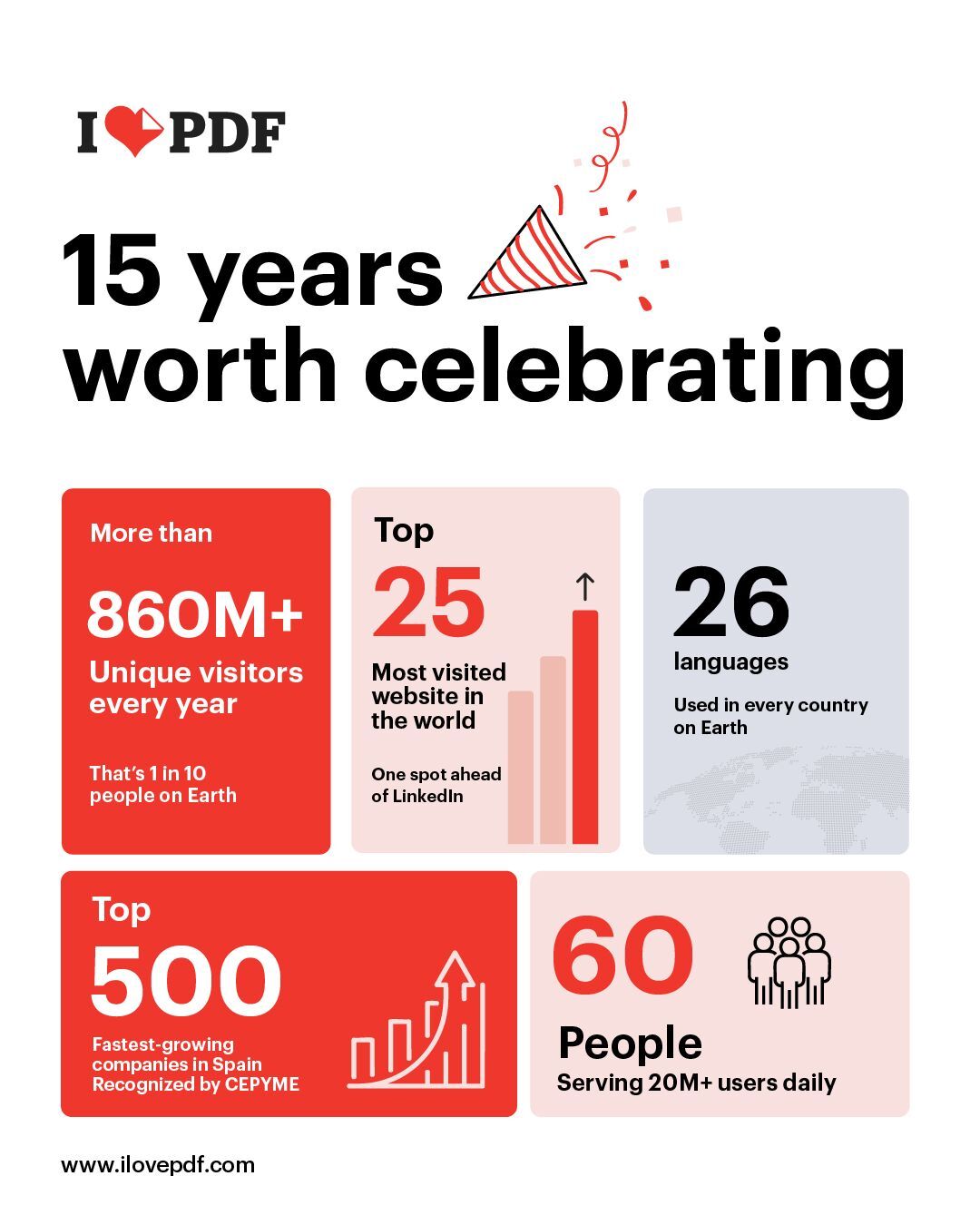
- iLovePDF now reaches more than 860 million unique visitors a year, roughly 1 in 10 people on the planet.
- It ranks among the top 25 most visited websites in the world, one spot ahead of LinkedIn.
- The platform is available in 26 languages and used in every country on Earth.
- iLovePDF has been recognised among the top 500 fastest-growing companies in Spain by CEPYME.
- A team of 60 people supports 20 million+ users every day.
- What began as a set of free PDF tools is now a full document management and e-signature platform used by international enterprises.
860 million people a year, and what that number really means
Big numbers are easy to print and hard to picture. So here's a way to think about 860 million unique visitors a year: that's about one in every ten people alive.
Most of them arrive for something small. A file that's too heavy to email. A scanned contract that needs to be signed today. Three separate documents that should have been one. They finish the task in under a minute and get on with their day.
That's the part we're proudest of. Nobody wakes up wanting to use a PDF tool. They want the thing on the other side of the PDF: the application submitted, the invoice sent, the paperwork off their desk.
Scale like this only happens if the tool disappears into the task. Fifteen years in, that's still the design brief.
Top 25 in the world: what it takes to stay there
Being among the 25 most visited websites in the world puts iLovePDF in unusual company. Search engines, social networks, video platforms. Utilities rarely make that list, and one spot ahead of LinkedIn is a strange place for a PDF tool to sit.
It's also a position you can't hold by accident. Traffic at that level means the infrastructure has to absorb enormous, uneven demand without slowing down: tax season in one country, exam period in another, month-end invoicing everywhere at once.
Three things keep it steady:
Speed as a feature, not a bonus. Processing happens fast enough that people don't leave mid-task. If a compression takes thirty seconds instead of three, the tool has failed.
Files that don't linger. Documents uploaded for processing are removed from our servers automatically after a short window. You can read the specifics in the iLovePDF security documentation, which covers encryption in transit and how file deletion works.
No account required for the basics. Most tools work without signing up. That's a deliberate choice, and it's a big part of why the number is what it is.
26 languages, every country on Earth
A document workflow in Madrid doesn't look like one in Jakarta or São Paulo. Different formats, different legal requirements, different expectations about what a signature means.
That last one matters more than it sounds. When a scanned page becomes searchable text, everything downstream gets easier: finding a clause, extracting a figure, feeding a document into another system. Our guide on how OCR works in iLovePDF walks through what happens between a scan and a searchable file.
Being genuinely global also means being useful offline and on the move, which is why the same toolset exists on desktop and on mobile for people who aren't at a computer when the document arrives.
Top 500 fastest-growing companies in Spain
iLovePDF was built in Spain and is still headquartered there. Being recognised by CEPYME among the country's 500 fastest-growing companies is a marker of something specific: growth that came from the product rather than from a marketing budget.
There was no launch campaign. People found a tool that worked, used it again the next week, and told a colleague. Fifteen years of that compounds.
It's worth saying plainly, because it shapes decisions. When growth comes from people choosing to come back, the incentive is to make the tool better, not louder.
60 people serving 20 million users a day
This is the number that surprises people most. Sixty.
Twenty million daily users supported by a team small enough to fit in one room says something about how the platform is built. Heavily automated, tightly scoped, with engineering effort spent on the parts that scale rather than on the parts that impress.
It also means the team stays close to the work. Support tickets reach the people who can fix the thing being complained about. Feature requests don't travel through six layers before someone reads them.
If you ever need to reach that team, the iLovePDF Help & FAQ is the fastest route, and it answers most questions before you have to ask.
From free PDF tools to a document platform
The iLovePDF of 2010 merged and split PDFs. The iLovePDF of today does considerably more, mostly because users kept asking for the next step in the workflow they were already halfway through.
Signing. Sending a document for signature is now part of the same platform, with signer tracking, audit trails, and legally valid electronic signatures. For teams, that removed a whole separate subscription. You can see how it works on the sign PDF page.
Long-term archiving. Organisations that need documents to stay readable for a decade or more convert them to a standardised archival format. Here's PDF/A conversion for long-term archiving and what changes when you use it.
Removing sensitive information properly. Drawing a black box over text does not delete the text underneath it. Real redaction strips the content out of the file. Our walkthrough on how to redact a PDF properly covers the difference and why it matters for anything you send outside your organisation.
Checking what changed. When a contract comes back from the other side, you need to know what moved. You can compare PDF versions online and see the differences side by side instead of reading twice.
The pattern across all of these is the same. Individuals get something quick and free, and teams with heavier requirements get the same tools with the controls, permissions, and compliance features an organisation needs.
What enterprises use it for
Alongside the millions of one-off visits, iLovePDF is used inside international enterprises for repeatable, high-volume document work.
What that typically covers: batch processing of invoices and statements, converting incoming scans into searchable archives, standardising output formats across departments, redacting personal data before files leave the business, and collecting signatures on contracts and internal approvals.
How iLovePDF approaches it: the same processing engine that serves a student compressing a CV serves an operations team running ten thousand files, with API access, team management, and documented data handling on top. Details of how files are stored, encrypted, and deleted are set out in our privacy policy.
Key behaviours to expect: files processed and then removed on a fixed schedule, encrypted transfer by default, and no use of customer documents for anything beyond the requested operation.
Is iLovePDF suitable for business and enterprise use?
Yes. iLovePDF is used by international enterprises as well as individuals. Business plans add team management, API access, higher processing limits, and administrative controls, while the underlying tools remain the same ones available to everyone.
Are files uploaded to iLovePDF deleted after processing?
Yes. Uploaded files are automatically removed from iLovePDF servers after a short, fixed period. Users can also delete their files manually at any point before that window closes.
Do you need an account to use iLovePDF?
No. Most iLovePDF tools work without registration. An account unlocks larger files, batch processing, cloud storage connections, and access to Premium features.
In summary
Fifteen years produced a set of numbers that are hard to believe: 860 million unique visitors a year, a top 25 global ranking, 26 languages, every country on Earth, all supported by a team of 60.
But the numbers are a side effect. What actually happened is that a lot of people had a document problem, found something that solved it in under a minute, and came back the next time. Repeated for fifteen years.
The next fifteen
The document work isn't finished. Files still arrive in the wrong format, scans still need to become searchable, contracts still need signing, and sensitive information still needs removing before anything gets sent.
What changes over the next fifteen years is how much of that happens without anyone having to think about it. More automation, more workflows that run end to end, more of the boring parts handled quietly in the background.
The commitment stays the same one it started with: tools that are fast, that respect your files, and that get out of your way once the job is done.
Thanks for fifteen years. None of the numbers above exist without the people behind them.
在我們這裏是有安全保障的
- 無論你使用的是哪種工具,我們都是採用端到端的加密方式,以便為你的文檔提供最高等級的防護,確保你的文檔不被非法竊取或攔截。
- 任何上傳至我們系統的文檔都將在2小時後自動刪除,以防止任何未經授權的第三方訪問。
- 我們所有的伺服器都受歐洲法律的保護,這是世界上最嚴格的法律之一。


